Pick the wrong gasket and your flange leaks on day one.
That's the opening line of our 30-second gasket selection Reel on Instagram, and it's the reason this article exists. The Reel shows the idea in one chart. Here I want to go a step further and explain why the chart works, where it stops working, and what I check before I put a gasket on a datasheet.
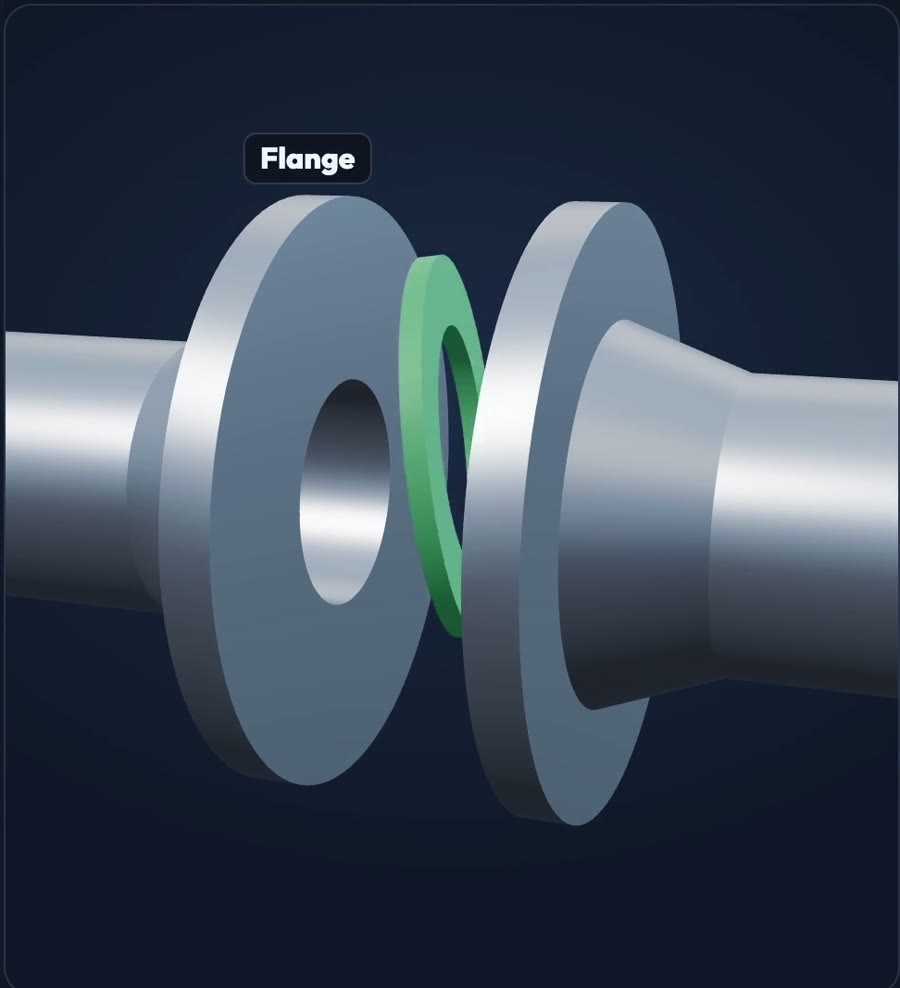
Gasket selection in 30 seconds
If you only remember one thing, remember this chart. It's a quick rule of thumb for choosing a flange gasket by pressure and temperature:
| Gasket type | Pressure | Temperature | Typical use |
|---|---|---|---|
| Flat ring gasket (soft, non-metallic) | Up to 40 bar | Up to 150 °C | Water, air, low-pressure utilities |
| Spiral wound gasket | Up to 70 bar | Up to 500 °C | Steam, hydrocarbons, most process lines |
| Grooved metal gasket (kammprofile) | Above 70 bar | Above 500 °C | High pressure, high temperature, heat exchangers |
Example: a steam line at 60 bar and 280 °C lands in the spiral wound zone.
These are typical ranges, not code limits. Your project piping class and the gasket manufacturer's data always win. I'll come back to that, because it matters.
Why gasket selection matters more than you think
A gasket is a small, cheap ring. It's also the only thing standing between the fluid inside the pipe and the people outside it.
In the Reel we put a rubber gasket on a steam line at 100 bar and 400 °C. As the pressure and temperature climb, the rubber softens, loses its grip on the flange faces, and the steam finds its way out.
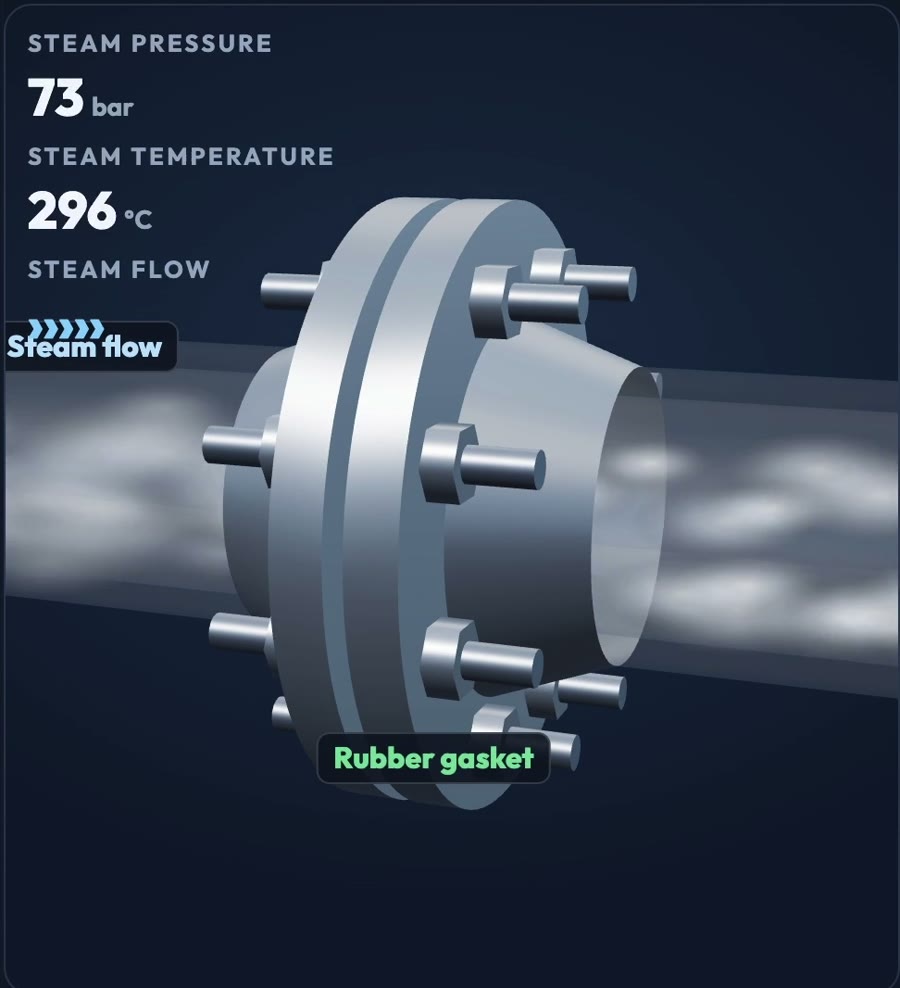
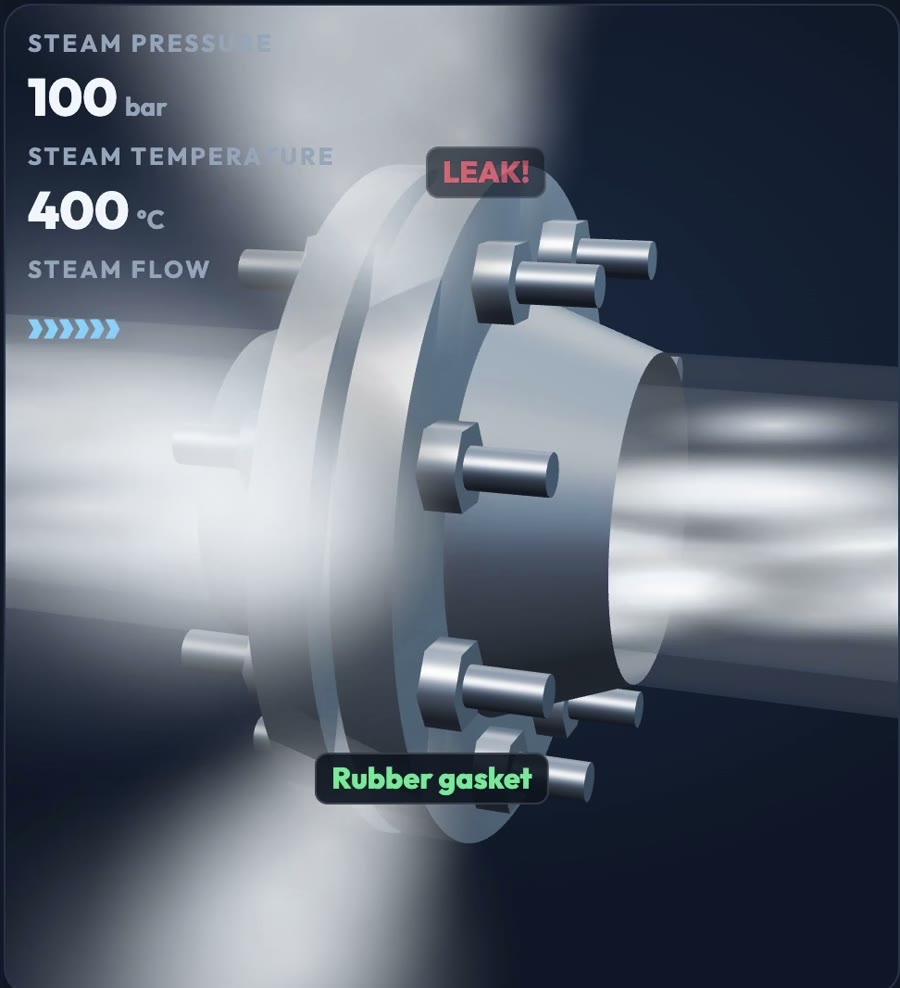
A leaking flange can mean a burn injury, a fire on a hydrocarbon line, a plant trip, or a shutdown to replace a part that cost almost nothing. That's why I treat gasket selection as a design decision, not a line item you copy from the last project.
How to read the gasket selection chart
The chart from the Reel has pressure (bar) along the bottom and temperature (°C) up the side. Each coloured zone is a gasket type. Find your design pressure and design temperature, put a point on the chart, and see which zone it lands in.
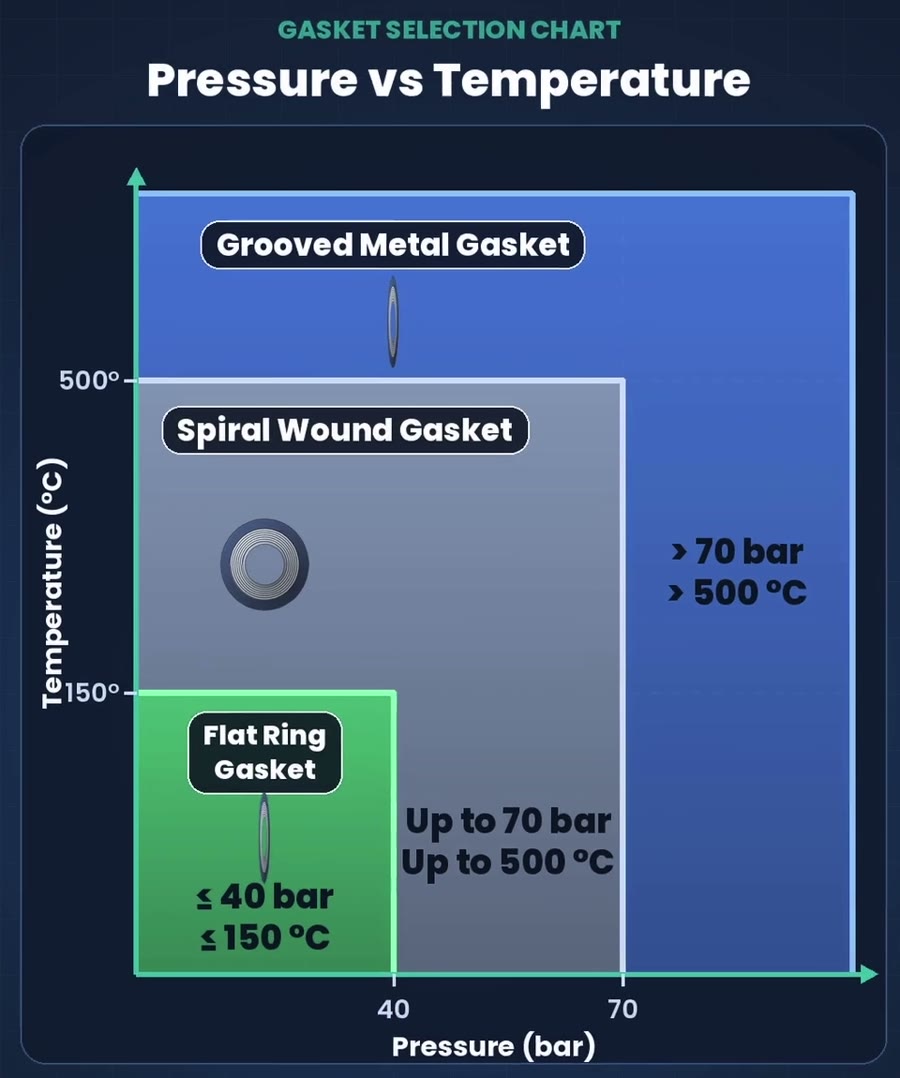
One thing I like about this chart: the zones are nested. A spiral wound gasket can also do the job of a flat ring gasket. It just costs more and needs more bolt load. So when a point sits on a boundary, go up a zone, not down.
Flat ring gaskets: up to 40 bar and 150 °C
Flat ring gaskets are cut from soft sheet material. Common materials are rubber (EPDM, neoprene, nitrile), compressed non-asbestos fibre (CNAF), PTFE and flexible graphite sheet. Their dimensions for ASME flanges are covered by ASME B16.21 (non-metallic flat gaskets for pipe flanges).
- Good for: cooling water, fire water, instrument air, low-pressure utilities, flat-face flanges on pumps and cast iron equipment.
- Watch out for: temperature. Most rubbers soften well before 150 °C, and each material has its own limit, so check the sheet material, not just the gasket type.
- My rule: keep rubber away from steam and hydrocarbons. If the fluid can burn or scald, I want something tougher.
Spiral wound gaskets: up to 70 bar and 500 °C
The spiral wound gasket is the all-rounder of process piping. It is a V-shaped metal strip (usually 304 or 316 stainless steel) wound in a spiral with a soft filler, usually flexible graphite or PTFE, between the turns. It sits between an outer centring ring that locates it inside the bolts and, in many cases, an inner ring that protects the windings and stops them buckling into the bore. Spiral wound gaskets are covered by ASME B16.20 (metallic and semi-metallic gaskets for pipe flanges).
- Good for: steam, condensate, hydrocarbons, most raised-face process flanges.
- Why it works: the metal spiral acts like a spring. It keeps pushing against the flange faces when the joint heats up, cools down, or the bolts relax a little.
- Watch out for: the filler. Graphite is the usual choice for heat, PTFE for chemical resistance at lower temperatures. B16.20 requires inner rings for PTFE filler and for larger sizes in the higher pressure classes, and many project specs make inner rings mandatory everywhere.
Grooved metal (kammprofile) gaskets: above 70 bar or above 500 °C
When the point lands above 70 bar or above 500 °C, the chart sends you to a grooved metal gasket, also called a kammprofile gasket. It has a solid metal core with fine concentric grooves on both faces, covered by a thin soft facing layer such as graphite. The grooves concentrate the bolt load into many small sealing lines, so it seals well at high pressure with a low seating stress. Grooved metal gaskets are also covered by ASME B16.20.
- Good for: high-pressure, high-temperature lines, heat exchanger girth flanges, joints that see thermal cycling.
- Bonus: the metal core can often be refaced and reused, while the facing is replaced.
- Also worth knowing: on flanges with a ring type joint (RTJ) facing, you use a solid metal ring (oval or octagonal) instead. RTJ flanges are common in the high pressure classes and in wellhead equipment. The flange facing decides this, not the chart.
Worked example: a steam line at 60 bar and 280 °C
Let's use the example from the Reel.
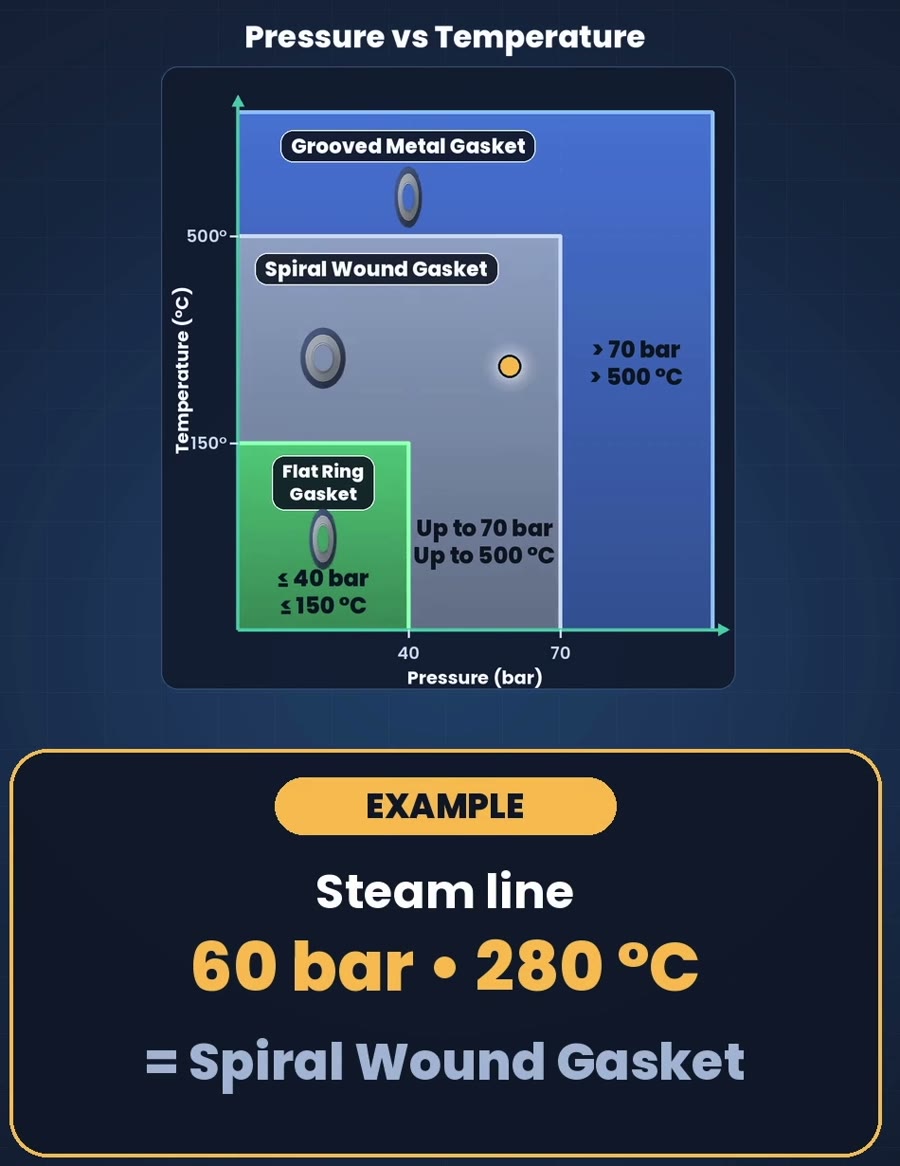
- Pressure: 60 bar. That's above the flat ring limit of 40 bar and below the spiral wound limit of 70 bar.
- Temperature: 280 °C. Far above the flat ring limit of 150 °C and well inside the spiral wound limit of 500 °C.
- Result: spiral wound gasket. For steam I'd specify stainless steel windings with graphite filler, and inner and outer rings.
Now the line from the start of the Reel: 100 bar and 400 °C. The temperature is fine for spiral wound, but the pressure is above 70 bar, so on this chart it moves up to a grooved metal gasket. And the rubber gasket we started with? It was never even close.
The questions I ask before I choose a gasket
Pressure and temperature get you to the right zone. These questions get you to the right gasket:
- What is the fluid? Water, steam, hydrocarbons, acids and oxygen all attack gasket materials differently. Chemical compatibility rules out materials before pressure ever comes into it.
- What are the design pressure and design temperature? Use design conditions, not operating conditions. Upsets, steam-out and start-up are where joints get tested.
- What is the flange class and facing? Raised face, flat face or ring type joint? The flange's own pressure–temperature rating (ASME B16.5 for most process flanges) must also suit the conditions, because the gasket is never the only limit.
- Is there cyclic or thermal shock service? Joints that heat up and cool down often need a gasket with good recovery, like spiral wound or kammprofile.
- Does it need to be fire-safe? On hydrocarbon lines, many specs ask for gaskets that keep sealing in a fire. Graphite and metal survive; rubber and PTFE don't.
- What does the project piping class say? On a real project the piping class (line class) already names the gasket. If your answer disagrees with it, raise it. Don't quietly change it.
Pop quiz from the Reel: which gasket for a pipe carrying oil?
In the Reel I asked: which gasket would you use for a pipe carrying oil? Here's how I'd answer it.
Start with pressure and temperature, like always. A lube oil line at 5 bar and 60 °C sits in the flat ring zone on the chart. But oil is flammable, so the fire-safe question changes the answer. Many refinery and power plant specs use a spiral wound gasket with stainless steel windings and graphite filler on hydrocarbon lines even at low pressure, because it keeps sealing in a fire. A nitrile rubber gasket can resist oil chemically, but it won't survive a fire.
So my answer is: check the chart, then check the fire-safe requirement and the piping class. What was your answer? Tell me in the comments on the Reel.
Common gasket mistakes that cause flange leaks
- Reusing a gasket. A gasket is designed to deform once. Once it has been compressed, it won't seal the same way again. Always fit a new one when a joint is opened.
- Wrong gasket for the flange facing. A spiral wound gasket on a flat-face cast iron flange can crack the flange when the bolts are tightened. Flat-face flanges usually get full-face soft gaskets.
- Too much or too little bolt load. Under-tightened joints leak. Over-tightened joints crush the gasket or yield the bolts. Use a controlled tightening procedure with the right torque or tension.
- Picking by operating conditions. The joint has to survive design conditions and upsets, not just a normal day.
- Ignoring the flange rating. A great gasket can't save a flange that's under-rated for the pressure and temperature.
A rule of thumb, not a rulebook
The chart is a quick way to think. It is not a code. Real gasket limits depend on the material, the filler, the flange size and class, and the bolt load. Before you finalise a gasket:
- Follow your project piping class and specification.
- Check the manufacturer's data for the exact gasket and material.
- Use ASME B16.20 (metallic and semi-metallic), ASME B16.21 (non-metallic) or EN 1514 for dimensions, and ASME B16.5 for flange ratings.
- For bolted joint calculations, use the gasket factors from your pressure vessel code and the gasket supplier.
Frequently asked questions
What is the best gasket for a steam line?
For most steam lines, a spiral wound gasket with stainless steel windings, graphite filler and inner and outer rings. At very high pressure or temperature, a grooved metal (kammprofile) gasket or a ring type joint is used. Rubber gaskets should not be used on steam.
What is the difference between a spiral wound and a kammprofile gasket?
A spiral wound gasket is a metal strip wound with a soft filler, and it acts like a spring. A kammprofile gasket has a solid grooved metal core with a thin soft facing. Kammprofile gaskets seal at a lower bolt load and handle higher pressures and thermal cycling better, while spiral wound gaskets are the common, cost-effective choice for most process flanges.
Which standard covers spiral wound gaskets?
ASME B16.20 covers metallic and semi-metallic gaskets for pipe flanges, including spiral wound, grooved metal (kammprofile) and ring joint gaskets. Non-metallic flat gaskets are covered by ASME B16.21.
Can I reuse a gasket after opening a flange?
No. Gaskets seal by deforming under bolt load, and they don't recover fully once compressed. Fit a new gasket every time the joint is opened. Some kammprofile cores can be refaced and reused, but the facing is always replaced.
Does gasket selection depend only on pressure and temperature?
No. Pressure and temperature narrow it down, but the fluid, flange facing, flange class, cyclic service, fire-safe needs and your project piping class all decide the final gasket.
Watch the 30-second version: Gasket selection Reel on Instagram. Save the chart for your next project, and follow @pipingmind_official for one piping concept at a time.
Keep learning:
- Why socket welds crack at high temperatures (Instagram Reel)
- What really decides pressure drop in a pipe (Instagram Reel)
- Free Pipe Pressure Drop Calculator for Excel, with a narrated how-to video